Last week, I stated that the Boundary Dam CCS project captured 400,000 tonnes of CO2 in the year to September 2015, less than half its target of 1 million tonnes of CO2.
In the last few weeks Saskpower released their figures for 2016. These figures shows a stark increase in the CO2 captured to 800,000 tonnes, a vast improvement.
Personally, I still think the finances surrounding the project are unethical and morally questionable. The project does however highlight the viability of CO2 capture technologies.
Economics & CCS
This paper by Koehlbl, B., et al. is due to be published on December 1st. The study models the impacts of a CCS dominated economy versus a status quo economy in the Netherlands. GDP and import dependency are effectively the same in the two scenarios, but unemployment is found to be slightly higher in a CCS economy.
Looking at studies such as this and examples like the Boundary Dam CCS project, the economics of CCS really don't strike me as being viable. Figure 2 in my last blog epitomises this - why bother with CCS when you can go renewable?
Thursday, 24 November 2016

Thursday, 17 November 2016
Boundary Dam CCS Project: A critical review
Last week I introduced the Boundary Dam CCS project. This post will explore some of the issues the pilot project has faced.
Cost - taxpayers subsidising private oil interests?
Everything discussed in this section is taken from this financial report and analysis of Boundary Dam CCS, from Saskwind. The figure below summarises the findings of the report.
The report, summarised here in this excellent article by David Roberts, finds:
Saskwind's report states that wind power (Saskatchewan is Canada's windiest province) could provide an equivalent amount of electricity over 30 years for just $450 million. That's a whole $1 billion less than the Boundary Dam CCS project.
Environmental Concerns
Probably the most fundamental component of a CCS facility is that it does what it says on the tin: captures carbon. Upon construction, Saskpower hailed that the Boundary Dam CCS project would capture 1 million tonnes of CO2 per year. However, in this September 2015 press release Saskpower stated that Boundary Dam had captured just 400,000 tonnes of CO2 in its first year of operation, less than half their target.
Stephan Melzer noted in his 2012 report on CO2 EOR that NUMBYISM (not under my backyard) was one of the major barriers to CCS development. He cited concerns about industrial subsurface storage, general mistrust of large industry and pollution. So how does Boundary Dam CCS compare to a 'normal' power station?
In this 2016 paper by Koiwanit, J., et al the effect of CCS upon atmospheric NOx and SO2 pollutants was studied. Reductions in NOx and SO2 emissions were observed at CCS sites. It was found that reductions in SO2 and NOx pollutants contribute to reductions in acute respiratory problems such as asthma. However, the post-combustion CO2 capture technique used at Boundary Dam was found to be much less effective at reducing atmospheric contaminants than oxy-fuel capture technologies.
Conclusions
Teething problems can be expected, but the suspect financial setup and poor CO2 capture record of Boundary Dam borders on the ridiculous. In terms of atmospheric pollutant reduction, Boundary Dam has been successful, but it is a small battle won in a very large war. To the residents of Saskatchewan, the Boundary Dam CCS project appears something of a white elephant. To Cenovous Energy? A piggy bank.
Cost - taxpayers subsidising private oil interests?
Everything discussed in this section is taken from this financial report and analysis of Boundary Dam CCS, from Saskwind. The figure below summarises the findings of the report.
 |
| Figure 1: Financial analysis of the Boundary Dam CCS project. |
- The $1.2 billion project budget eventually overran to $1.47 billion.
- $240 million of this was payed for by the Canadian federal government, the other $1.23 billion by Saskpower's electricity customers (via their bills).
- Over the plant's 30 year lifetime:
- The plant will earn $713 million from the sale of CO2 and $391 million from electricity sold.
- If the construction and upkeep costs of the CCS facility are subtracted from this profit, the CCS facility will make a $1,042 million loss overall.
- The total loss for Saskpower's customers equals -$651 million.
In the meantime, Cenovous Energy, the oil company using the captured CO2 to extract oil from the Weyburn oil field, will net a $1,823 million profit from oil sales. Of this, an estimated $1,000 million will be oil sales made possible by EOR using CO2 from Boundary Dam.
The upshot? Saskatchewan tax payers subsidise Cenovous Energy's $1 billion profits to the tune of $650 million. I don't know about you, but that doesn't sound like a flagship environmental project to me.
The alternative? According to this figure from the US Energy Information Administration's 2016 outlook, the cost of Hydro, Wind, Solar PV and Biomass renewable energy sources are all significantly lower than the cost of new CCS coal fired power stations.
 |
| Figure 2: Cost of different electricity sources. |
Environmental Concerns
Probably the most fundamental component of a CCS facility is that it does what it says on the tin: captures carbon. Upon construction, Saskpower hailed that the Boundary Dam CCS project would capture 1 million tonnes of CO2 per year. However, in this September 2015 press release Saskpower stated that Boundary Dam had captured just 400,000 tonnes of CO2 in its first year of operation, less than half their target.
Stephan Melzer noted in his 2012 report on CO2 EOR that NUMBYISM (not under my backyard) was one of the major barriers to CCS development. He cited concerns about industrial subsurface storage, general mistrust of large industry and pollution. So how does Boundary Dam CCS compare to a 'normal' power station?
In this 2016 paper by Koiwanit, J., et al the effect of CCS upon atmospheric NOx and SO2 pollutants was studied. Reductions in NOx and SO2 emissions were observed at CCS sites. It was found that reductions in SO2 and NOx pollutants contribute to reductions in acute respiratory problems such as asthma. However, the post-combustion CO2 capture technique used at Boundary Dam was found to be much less effective at reducing atmospheric contaminants than oxy-fuel capture technologies.
Conclusions
Teething problems can be expected, but the suspect financial setup and poor CO2 capture record of Boundary Dam borders on the ridiculous. In terms of atmospheric pollutant reduction, Boundary Dam has been successful, but it is a small battle won in a very large war. To the residents of Saskatchewan, the Boundary Dam CCS project appears something of a white elephant. To Cenovous Energy? A piggy bank.
Thursday, 10 November 2016
Boundary Dam Carbon Capture Project: A working CCS case study
Background
Having divulged my thoughts on the geological viability of CCS and how to market CCS to the public over the last few weeks, I thought that this week I would present to you an in depth case study of CCS in action.
The Carbon Brief, though a little dated, provides a good overview of current CCS projects around the globe.
The first example I encountered was the Boundary Dam CCS project in Canada, marketed by its owner, Saskpower, as "The world's first post combustion CO2 capture coal fired power station".
The project, described in depth here constitutes:
Little data (probably purposefully) is available based on net CO2 emissions from CCS taking into account CO2 produced by extra crude production. So I thought i'd try for myself*:
Having divulged my thoughts on the geological viability of CCS and how to market CCS to the public over the last few weeks, I thought that this week I would present to you an in depth case study of CCS in action.
The Carbon Brief, though a little dated, provides a good overview of current CCS projects around the globe.
 |
| Figure 1: CCS projects around the globe. Just 3 of the 22 projects (in 2014) under construction or operational were working power stations. |
Boundary Dam CCS Project
The project, described in depth here constitutes:
- The regeneration of an ageing coal fired power unit into a more efficient, reliable generator of 115 megawatts of electricity per year.
- The capture of up to 90% of CO2 produced by the unit, reducing CO2 emissions by up to one million tonnes per year (the equivalent of 250,000 cars).
- Capture of other byproducts, such as SO2 and NOx, which are then sold to industry.
For further information, see this Department for energy and climate change blog here, and this rather self-indulgent and technical scientific paper by Karl Stephenne here. This (dry and corporate) youtube video from Saskpower also outlines the scheme well:
So far so good - coal is a cheap source of reliable electricity. With a 90% reduction in CO2 emissions, coal becomes a reliable, cheap and environmentally friendly source of electricity. However, there are caveats.
Destination of captured CO2
The clue is in the name, carbon capture AND storage; Boundary Dam CCS project does the capturing well, but the storage? Not so much.
"Most" of the captured CO2 is "transported by pipeline to nearby oilfields where it will be used for enhanced oil recovery (EOR)".
So this project isn't CCS at all! It is merely a source of CO2 to fuel an oil extraction method that has existed for generations.
 |
| Figure 2: Oil recovery at the nearby Weyburn oil field increased by ~250% when EOR methods were employed in the mid 2000's. |
- According to the US Energy Information Administration, ~170kg of CO2 is created from a barrel of oil (if converted into petrol and combusted).
- An extra ~15,000 barrels of oil a day was produced each day due to EOR at Weyburn oil field (at injection rates of 1,800,00 tonnes of CO2 per year).
- This equates to 475,000 extra barrels of oil produced a year based on 365 days a year production.
- Post-combustion, this equates to 930,750,000kg of CO2 per year, or 930,750 tonnes, based on the US EIA's figure.
- The Boundary Dam project captures ~1,000,000 tonnes of CO2 per year. Assuming 'most' means ~90% then 900,000 tonnes of this is used for EOR.
- ~1,800,000 tonnes of CO2 a year was injected at the Weyburn oil field. Boundary dam will contribute approximately half this amount (~900,000 tonnes) to EOR a year.
- Based on this assumption, approximately 465,375 (930,750 / 2) tonnes of CO2 will be created per year from the combustion of oil produced from CO2 captured at Boundary Dam.
In short, this means that the Boundary Dam CCS project produces 115 Megawatts of electricity per year, with minimal (<10% of the norm) CO2 emissions. However, the project then effectively releases ~465,000 tonnes of CO2 per year from oil combustion.
Conclusions
There are many assumptions in this rudimentary back of the envelope calculation, but what is clear is that there are distinct environmental benefits to CCS-EOR. Negative, or net zero emissions, are not attainable via this method. For this, highly efficient storage within geological formations would be required.
But, we live in a world addicted to electricity, addicted to oil. There exists a whole different debate encompassing whether or not we should continue to use fossil fuels in the face of climate change. But, in a world unlikely to go teetotal anytime soon, projects such as this can help to drastically reduce, though not eradicate, CO2 emissions.
Now, this line of argument ignores the nitty-gritty world of economics, of safety and of politics. My next post will explore these issues in relation to the Boundary Dam CCS project.
Until then...
*calculations based upon Weyburn oil field, an oilfield in the Boundary Dam region which underwent EOR in the mid 2000's. At the the time Weyburn was the largest CCS project in the world. Injection of CO2 into the Weyburn field was 1,800,000 tonnes per year.
Tuesday, 1 November 2016
Marketing CCS: What is an attractive proposition?
Context
I have just finished watching "Before the Flood". If you haven't, its essentially 90 minutes of Leonardo Di Caprio indulging in smug environmentalism. Nonetheless, it also contains some accurate, thought-provoking climate science and, regrettably, some scaremongering too. The documentary is available on Youtube, see below.
After watching, I read the comments from Youtube users who watched the documentary. Many of the comments struck a familiar theme. Despite having spent 90 minutes of their lives watching a documentary about climate change, many didn't want their lifestyles to be influenced in combatting climate change.
Veganism? Eurgh, all those leaves.
Electric cars? But i'm charging my iPad, where do I plug it in?
No beef? What, not even Mcdonalds?
Renewable energy? Oh, but all those ugly windmills! Its all a hoax anyway, DONALD KNOWS!
Marketing Carbon Capture and Storage (CCS)
Watching and reading I began to think about the role of CCS in combatting climate change. What would be the opinion of the commenters? If CCS was to become a major component of our energy system, how would it go about succeeding where other initiatives have failed - in getting the public on side?
I came up with a four point plan. If, tomorrow, I was put in front of a politician and told to convince them to implement CCS, this is what i'd say:
Moving on
In my earlier posts I have explored the geological aspect of CCS. My remaining posts will explore the viability of the above statements - as well as other questions such as: What does CCS mean for energy bills? Is it economically viable? Where is public opinion?
Keep your eyes out!
I have just finished watching "Before the Flood". If you haven't, its essentially 90 minutes of Leonardo Di Caprio indulging in smug environmentalism. Nonetheless, it also contains some accurate, thought-provoking climate science and, regrettably, some scaremongering too. The documentary is available on Youtube, see below.
After watching, I read the comments from Youtube users who watched the documentary. Many of the comments struck a familiar theme. Despite having spent 90 minutes of their lives watching a documentary about climate change, many didn't want their lifestyles to be influenced in combatting climate change.
Veganism? Eurgh, all those leaves.
Electric cars? But i'm charging my iPad, where do I plug it in?
No beef? What, not even Mcdonalds?
Renewable energy? Oh, but all those ugly windmills! Its all a hoax anyway, DONALD KNOWS!
Marketing Carbon Capture and Storage (CCS)
Watching and reading I began to think about the role of CCS in combatting climate change. What would be the opinion of the commenters? If CCS was to become a major component of our energy system, how would it go about succeeding where other initiatives have failed - in getting the public on side?
I came up with a four point plan. If, tomorrow, I was put in front of a politician and told to convince them to implement CCS, this is what i'd say:
- Emphasise that no change in lifestyle is needed on the part of the consumer. CCS essentially allows guilt free use of popular energy intensive products. This is touched upon in this paper (in press) by Kruger, T. Kruger discusses how CCS has become more attractive in the face of the Paris Agreement because of how it supports the continued dominance of a centralised fossil fuel industry.
- Encourage investment and support from big business on the basis of the potential economic benefit from CCS. One such example would be petroleum companies, who would benefit from a policy which doesn't inhibit their profits. Again this is discussed in the Kruger paper. Kruger highlights that the behaviour of consumers can often mirror the opinion of large corporations because of advertising and marketing campaigns.
- Highlight the weaknesses of the rivals. For example, CCS allows continued energy production from reliable sources such as gas and coal. Alternatives, such as renewables, can be unreliable in their supply. However, the success of countries such as Uruguay in implementing renewables may make this pitch difficult.
- Don't alienate people. I can't emphasis the importance of this enough. Don't push people to supporting CCS. In some circles of society, such as the middle-class intelligentsia, refuting environmentalist ideas is viewed as sacrilege. Outside of these circles, resentment can build when such accusations are made, promoting the alternate viewpoint. One such dividing example is the Prius - Toyota's hybrid car. To a person struggling to make ends meet, it represents a clique of well-educated, sandal wearing, vegan environmentalists out of touch with the plight of the average person. See this blog from an angry American. CCS must not be tarnished with this brush.
Conclusions
Without the support of the Youtube commenters, any future development in CCS is doomed to failure. Only with a broad spectrum of public opinion can such a large undertaking ever work. Only through a targeted marketing campaign is this possible. Perhaps most importantly, it mustn't alienate the very people it hopes to recruit.
In my earlier posts I have explored the geological aspect of CCS. My remaining posts will explore the viability of the above statements - as well as other questions such as: What does CCS mean for energy bills? Is it economically viable? Where is public opinion?
Keep your eyes out!
Wednesday, 26 October 2016
Balancing the argument: A further short note on the geological viability of CCS
Background
Further to my musings a little under a week ago, I have been further investigating the geological viability of CCS. I ended my last post with a rosy outlook, suggesting that CCS really made sense from a geological viewpoint.
Further research
After some further reading I came across a study which refutes this viewpoint. Lawter et al. (2015) conducted an experiment into the effects of sequestering CO2 when a CO2 reservoir is overlain by an unconsolidated aquifer (poorly consolidated sedimentary rocks containing groundwater).
The study, conducted in the laboratory, found that some soluble elements, such as sodium, arsenic, magnesium, molybdenum and strontium, would leak into the aquifer if CO2 was injected.
Implications
These results are significant because elements such as arsenic and molybdenum are toxic. Should these elements enter the groundwater supply they would have the potential to threaten human life.
My opinion
The paper is important in highlighting how element mobility can change after CO2 injection. However, I personally believe that with adequate prior research and knowledge, potentially dangerous CO2 sequestration sites can be avoided. This is a relatively simple and cheap process, this study by Bachu (2002) sets out the options for different CO2 sequestration sites.
I also approach the findings within the paper with some scepticism. This is because of the purely chemical nature of the experimentation. The paper doesn't take into account geological factors, such as explaining the pathway along which such contaminants would travel into the aquifer. As mentioned in my previous post, CCS generally takes place in the presence of an impermeable barrier between the sequestered CO2 and overlying sediments. The studies (e.g Chadwick et. al 2005) discussed in my previous post found that CO2 didn't leak into overlying aquifers when sequestered.
This research is undoubtedly a barrier to CCS development, rightly so, given the potential human impact. However, I believe that it is preventable with proper site choice and management. Because of this, I still believe that CCS makes geological sense.
Further to my musings a little under a week ago, I have been further investigating the geological viability of CCS. I ended my last post with a rosy outlook, suggesting that CCS really made sense from a geological viewpoint.
Further research
After some further reading I came across a study which refutes this viewpoint. Lawter et al. (2015) conducted an experiment into the effects of sequestering CO2 when a CO2 reservoir is overlain by an unconsolidated aquifer (poorly consolidated sedimentary rocks containing groundwater).
The study, conducted in the laboratory, found that some soluble elements, such as sodium, arsenic, magnesium, molybdenum and strontium, would leak into the aquifer if CO2 was injected.
 |
| Figure 1: From Lawter et al. 2015. Injection of CO2 into an aquifer causes a reduction in pH. This subsequently increases the mobility of many elements (see below). |
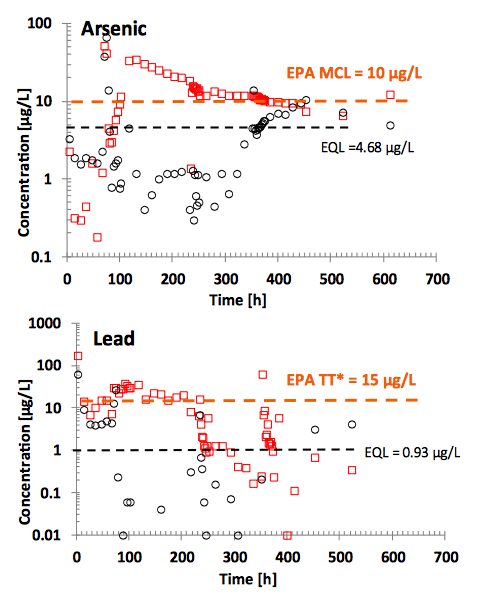 |
| Figure 2: From Lawter et al. 2015. Increases in concentrations of toxic lead and arsenic, surpassing the safe levels defined by the EPA (US Environmental Protection Agency). These increases in concentration correlate with CO2 injection. |
Implications
These results are significant because elements such as arsenic and molybdenum are toxic. Should these elements enter the groundwater supply they would have the potential to threaten human life.
The paper is important in highlighting how element mobility can change after CO2 injection. However, I personally believe that with adequate prior research and knowledge, potentially dangerous CO2 sequestration sites can be avoided. This is a relatively simple and cheap process, this study by Bachu (2002) sets out the options for different CO2 sequestration sites.
I also approach the findings within the paper with some scepticism. This is because of the purely chemical nature of the experimentation. The paper doesn't take into account geological factors, such as explaining the pathway along which such contaminants would travel into the aquifer. As mentioned in my previous post, CCS generally takes place in the presence of an impermeable barrier between the sequestered CO2 and overlying sediments. The studies (e.g Chadwick et. al 2005) discussed in my previous post found that CO2 didn't leak into overlying aquifers when sequestered.
This research is undoubtedly a barrier to CCS development, rightly so, given the potential human impact. However, I believe that it is preventable with proper site choice and management. Because of this, I still believe that CCS makes geological sense.
Wednesday, 19 October 2016
Carbon Capture and Storage (CCS) - a geological perspective
Background
The process of Carbon Capture and Storage is divided into 3 phases:

The process of Carbon Capture and Storage is divided into 3 phases:
- CO2 capture
- Transport to a suitable location
- CO2 storage in subsurface
As something of a geology fiend, I am particularly interested in how CO2 is stored within rocks. It is this topic that I will address within this post.
Geological requirements
CO2 can be stored in rocks with the following charecteristics (Bachu 2008):
- A high porosity (large spaces between sedimentary grains) to be able to uptake CO2
- A high permeability (ability for CO2 to travel between pore spaces, so that CO2 can be pumped into the ground at a rate which makes it worthwhile)
- A formation overlain by a cap rock (An impermeable rock which prevents the upward migration of CO2, which has a natural tendency to do so because of its low density)
The 3 characteristics outlined in the paper are somewhat simplified, particularly because of the effect of geological structures. For example, if the sequestration site was cross-cut by faults (structural planes of weakness), these could act as permeability pathways which would allow CO2 to migrate towards the surface and escape.
Enhanced oil recovery (EOR)
When I began to research this topic, the same point was mentioned in almost every paper abstract that I read (e.g Steeneveld et al. 2010). That point was that the storage of CO2 within geological formations is already widespread. This is because CO2 has been used as an enhanced oil recovery method for decades, particularly in the US.
This review paper by Alvarado & Manrique provides an overview of the use of CO2 for enhanced oil recovery. Put simply, CO2 is pumped into oil reservoirs when recovery yields begin to decline. The less dense CO2 displaces the oil present in pore spaces of rocks, forcing it up a well to the surface. In many cases this can increase reservoir yield by 10-15%. The following youtube video from Richland Community College represents the process using a jar of rocks, effervescing tablets, vegetable oil and water.
It is somewhat misleading to suggest that the act of geologically sequestering CO2 is commonplace, as the ultimate destination of sequestered CO2 isn't the priority of oil companies employing the method; they are driven entirely by oil yield.
This statement also ignores the irony of the process, in that CO2 is used as a mechanism to produce more CO2-producing fuels. Because of this, the ability of CO2 to escape geological formations and the geological viability of the process has, until relatively recently, been poorly understood.
What can we learn from EOR?
Though little information of the sub-surface behaviour of CO2 can be gleaned from EOR, there are valuable lessons to be learnt for CCS. Namely, EOR proves the viability of large infrastructure projects that exist solely to collect CO2 from industrial processes, transport it and deposit it in geological formations (Bachu 2008).
Indeed, as a non-flammable and non-toxic gas (until very high concentrations) it is much safer than other commonly exploited gases such as Hydrogen and Ammonia. Bachu (2008) notes that the greatest threat posed by release of CO2 from sequestration infrastructure is actually global warming.
Seismic imaging of CO2
So, if the oil industry isn't undertaking comprehensive research to understand what happens to CO2 when it is injected into the subsurface, how can we begin to understand how it behaves?
Ironically, the technique commonly used to image sequestered CO2, seismic imaging, is a product of the evolution of oil exploration. Seismic imaging essentially involves the production of sound waves on the land/sea surface, which propagate down into subsurface rock layers.
Depending upon the compressibility of each rock layer (how easy it is to squash) the characteristics of the reflected seismic waves will vary. Using this information, scientists can reconstruct the subsurface geology. The process is explained in this youtube video below from the Queensland Resources Council.
This technique was created for oil exploration purposes to hunt for oil and gas within the subsurface. As global demand for oil has increased, the technique has evolved and improved. 3D seismic surveys are now commonplace in the oil industry.
For the purposes of tracking sequestered CO2, 4D seismic is used. This is essentially 3D data taken at different time intervals. This review paper by Lumley 2010 explains the principles of 4D seismic interpretation for imaging CO2 in the sub-surface. This is a good high level explanation of the process, however the simple statement that the CO2's low compressibility relative to dry rock allows it to be imaged within the subsurface isn't eluded to in the paper.
4D seismic imaging of sequestered CO2 - a case study
This paper from Chadwick et al. (2005) explains how CO2 in the North Sea was injected into a saline aquifer (porous body of rock with a high concentration of saline water in its pore spaces) between 1991 and 2001.
Using 4D seismic imaging the authors were able to view the evolution of the injected CO2 plume over 10 years. They observed that the CO2 remained confined to the targeted rock layers, and that no loss of CO2 occurred. The evolving CO2 plume is shown in the diagram below.

This study and others (see Alnes et al. 2008) suggest that the risk of CO2 escape from storage is low. Other 4D seismic studies (Verdon et al. 2010) have found that there has been little or no influence upon earthquake activity from CO2 injection.
Conclusion
Existing EOR projects highlight the safety & viability of infrastructure dedicated to CO2 capture, transport and storage. Seismic imaging has found that the threat of CO2 escape from geological formations is negligible. Other threats, such as earthquakes induced by increased stresses within rocks due to CO2 input, have also been debunked. From a purely geological standpoint, CCS really does make sense.
Further reading
If this post hasn't satisfied your thirst for CCS knowledge, this lecture from Biondo Biondi further explains the use of 4D seismic imagery to image CO2.
Thursday, 13 October 2016
CCS - a brief overview
The Start of my Blogging Journey
Today I began to grapple with a problem: Carbon Capture
& Storage (CCS) - could this be the answer to securing our climate future?
As a geology graduate I was somewhat disappointed in myself
when I realised I knew so little about this topic. Speaking to friends and
colleagues, I realised that this was by no means endemic to just me. Many people know broadly what CCS is, but few knew:
- If it has yet been implemented.
- The geological principles which allow it to occur.
- Any observed or modelled adverse effects.
- Its viability, cost or effectiveness.
So, herein I will embark on a journey of discovery into the
murky underground world of CCS, essentially asking; is it viable? I will be
running this blog over the next few months, with a view to publishing 5-6 blogs a month. The blog will be
structured around a number of different themes:
- Presenting, explaining and critiquing research in the field from scientific journals.
- Approaching what I find from the viewpoint of different stakeholders within the environmental sector, e.g private sector businesses, environmentalists, policymakers, academia and the general public.
- Regular updates on relevant media, news and scientific literature in the field.
- Regular dialogue with readers of the blog, including debate and discussion.
CCS - a brief overview
Following the ratification of the Paris Climate Agreement on
October 5th, all the signatories of the agreement will be legally bound to
limiting global temperature increases to below 2 degrees from November 4th.
Under a "business as usual" scenario (i.e an
emissions pathway with no declining rate of CO2 emissions and no policy action)
such as RCP 8.5, up to 4 degrees of global temperature increase has been
modelled by 2100.
 |
Figure 1: The red line denotes the RCP8.5 emissions pathway. This is the pathway we find ourselves on today, with no reductions in greenhouse gas emission rates occurring in future decades. Taken from IPCC 2013 WG1 Chapter 12.
|
Evidently, society
needs to find a solution to its carbon addiction. Most policy ideas aimed at
mitigating global temperature rise involve reducing the amount of carbon that
we emit. Examples include cap and trade, renewable energy schemes and electric vehicles.
However, what if the
answer to our addiction doesn't lie in reducing the amount of carbon we emit,
but merely in preventing that carbon from entering our Earth's atmosphere? This
is the fundamental principle of CCS - trapping CO2 emitted from power stations,
cement factories and other heavy CO2 emitters and storing it beneath the
Earth's surface.
The idea really is
that simple. The process is essentially the reverse of how natural gas is
extracted from gas reservoirs. Once natural gas has been extracted, the pore
spaces (spaces between grains within rocks) are left empty. Pumping captured
CO2 back into these reservoirs allows CO2 to fill these pore spaces, preventing
it from entering the atmosphere. The video below, made by the British Geological Survey, explains how the process occurs in the North Sea.
My view
CCS seems almost to
good to be true. The idea that we can take the main driver of global
temperature rise and bury it in the ground is almost utopian. But what is the
state of the science?
Problems surrounding
economics (wouldn't this money be better invested in renewable energy sources),
safety, viability, infrastructure and ethics all come to the fore. It is these
themes that I will explore over the coming months as I look to answer the
question "Is Carbon Capture and Storage key to securing our climate
future?".
Until next time.
Lewis
Subscribe to:
Posts (Atom)